Justice Tarot Card Meaning, 35 Interpretations!

Justice sits at number eleven in the Major Arcana, the exact hinge of the deck, and she sits the way a judge sits when court is finally in session. No pacing, no fidgeting. A crowned figure on a stone throne between two grey pillars, a sword held perfectly upright in her right hand, a set of scales resting level in her left. Behind her hangs a purple veil, and on her chest a square clasp pins her green mantle over a red robe. Look closely at the bottom of the card and you will see a single white foot emerging from under the hem, as if she is about to stand.
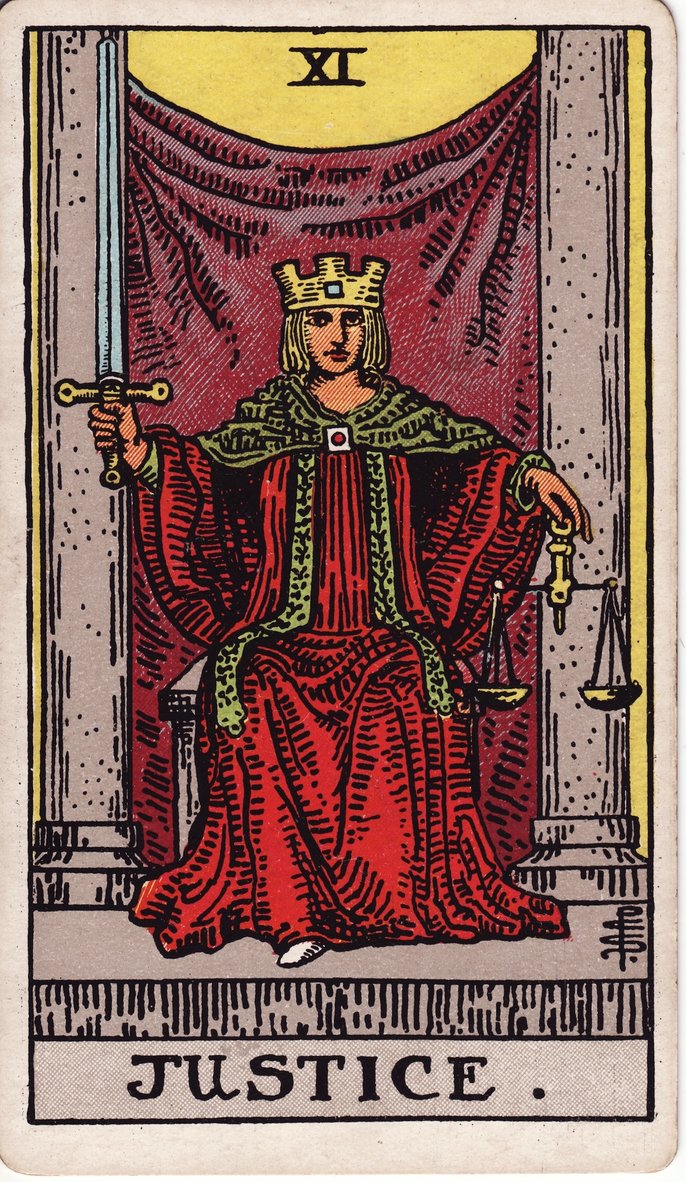
Every one of those details is doing work.
The sword points straight up because truth, in this card, is not a weapon you swing at people. It is a standard you hold. It is double-edged for a reason: whatever you use it on cuts back toward you with the same sharpness. The scales in her left hand are not being adjusted or fussed over. They simply show what is, the way a bathroom scale shows what is, whether or not you had plans for that number.
The purple veil is the detail most people miss. Purple is the color of hidden wisdom, and the veil hangs between the pillars the way it does behind the High Priestess. The message is quietly radical: behind human law there is a deeper order, and the verdicts that matter are not always the ones read aloud in a courtroom. The square clasp holding her mantle says the same thing in geometry, structure containing passion, order holding the red robe of raw feeling in place without smothering it.
And that foot slipping out from beneath the robe? Justice is not a statue. She is about to act. Decisions in this card do not stay theoretical for long.
Here is the thing that separates her from the courthouse statues you have seen: this Justice wears no blindfold. Her eyes are open, and she is looking directly at you. She does not need to be blind to be fair. She has seen everything, weighed everything, and she is still calm. That gaze is the whole card.
Justice arrives after the Wheel of Fortune has spun your circumstances around and just before the Hanged Man asks you to surrender. The Wheel is what happens to you. Justice is what you did about it, itemized. This is the card of cause and effect, of decisions made with a clear head, of consequences arriving neither early nor late but exactly on time.
This guide walks through every reading position, upright and reversed, so you know precisely what she is saying when she turns that steady gaze on you.
What does the Justice Tarot Card mean?
Upright, Justice means the accounts are being settled, and they are being settled accurately.
Not dramatically. Accurately. Justice is not the lightning bolt of the Tower or the trumpet blast of Judgement. She is the quiet moment when the results come back and they match, almost embarrassingly well, what you actually put in. If you have been doing the work, this card is wonderful news. If you have been cutting corners and hoping nobody runs the numbers, she is the one who runs the numbers.
In a reading, Justice points to truth surfacing, fair outcomes, legal matters resolving, and decisions that need to be made with the head fully engaged. She often shows up when you are standing at a fork and the honest option is also the harder one. Her advice is always the same: take it anyway. The sword only stays upright when you do.
She also carries a promise that people who have been treated unfairly badly need to hear. The scales level out. Maybe not this week, and rarely on the schedule you would choose, but the universe of this card keeps immaculate books. What you are owed is not lost. It is pending.
There is one catch, and it is the catch that makes Justice an adult’s card rather than a wish-granting one. She gives you what you have earned, not what you have wanted. Sometimes those are the same thing. When they are not, she does not apologize. She just looks at you with those open eyes, and somewhere in you, you already knew.
That is the strange comfort of Justice. You never have to wonder where you stand. You are standing exactly where your choices put you.
Justice Tarot Card Keywords:
- Fairness
- Truth
- Cause and effect
- Accountability
- Balance
- Clarity
- The law
- Legal matters
- Karma
- Honest decisions
- Objectivity
- Consequences
- Integrity
- Earned rewards
What does the Justice Tarot Card mean when Reversed?
Reversed, Justice means the scales are tipped and somebody, possibly you, tipped them.
This is the card of the thumb on the scale. Of the story you tell about the argument that leaves out the part where you started it. Of biased judgment, dodged accountability, and consequences that are currently in transit whether you track the package or not. When Justice lands upside down, truth is being avoided somewhere in the situation, and the reading is inviting you to find out where.
Sometimes the injustice is external and real. You were passed over, lied about, shortchanged, or judged by someone who never bothered to learn the facts. Reversed Justice acknowledges that plainly. The scales are genuinely crooked, and no amount of positive thinking will straighten someone else’s thumb.
But be honest, because this card demands it: at least as often, the crooked scale is internal. You are judging yourself with a harshness no court would allow, prosecuting old mistakes past their sentence. Or you are doing the opposite, cross-examining everyone else’s behavior while your own gets a sympathetic jury of one. Reversed Justice loves to appear for people who are excellent lawyers on their own behalf.
She can also point to perfectionism, which is just injustice aimed inward. Setting a bar no human could clear, then punishing yourself for being human, is not high standards. It is a rigged trial.
And if there is an actual legal or formal matter in play, the reversal counsels caution. Something has been overlooked, a detail, a document, a downside. Slow down and reread the fine print, including the fine print of your own motives.
The good news is that reversed Justice is never a life sentence. She is a correction notice. Face what is true, make it right where you can, and the scales, which want to be level, come back to center faster than you would think.
Justice Reversed Keywords:
- Unfairness
- Dishonesty
- Bias
- Avoidance of accountability
- Double standards
- Harsh self-judgment
- Perfectionism
- Legal complications
- Corruption
- Guilt
- Imbalance
- Consequences catching up
- Denial
- Rigidity
Justice as How Someone (He/She) Sees You
When Justice describes how someone sees you, they see the person they call before making a big decision.
You are, in their eyes, the fair one. The level head. The friend who will not just take their side automatically, which occasionally annoys them and is precisely why your opinion is worth something. When you say “you were right,” it lands, because they have heard you say “you were wrong” too.
They notice that you keep your word with a consistency that is almost old-fashioned. If you said you would be there Thursday, you are there Thursday. In a world of soft commitments and last-minute cancellations, that reads as quietly remarkable, and they have absolutely noticed.
There is respect in this perception, real and durable. There may also be a small, careful distance. People behave a little better around you, the way drivers behave a little better next to a police car, and not everyone finds that relaxing. Some people will keep their messier selves out of your view, not because you judge them out loud, but because those open eyes of yours miss nothing and they know it.
If you were hoping this person sees you as wild and irresistible, this may feel like a lukewarm result. Do not undersell it. Being seen as fair is rarer than being seen as fun. Fun gets invited to the party. Fair gets asked to hold the ring, witness the signature, and hear the thing they have told no one else.
Justice Reversed as How Someone (He/She) Sees You
Reversed, this position is uncomfortable but useful: the person sees you as judge, jury, and occasionally executioner, and not in an admiring way.
They may experience you as cold when you think you are being clear. As rigid when you think you are being principled. Your feedback, which in your head is honest and helpful, may be landing on them like a verdict read out in open court. Notice whether people have stopped telling you things. That silence is evidence.
Alternatively, they may see you as someone whose rulings do not match their own record. The friend with a firm opinion on everyone’s choices and a generous explanation for their own. Double standards are invisible from the inside and blinding from the outside, which is exactly why this card shows up to hold the mirror.
There is a third possibility worth weighing: their perception is simply wrong. Reversed Justice can mean you are being misjudged, tried on partial evidence, assigned motives you never had. If so, defend yourself once, plainly, and then stop. You cannot win an appeal in a court that has already decided, and endless re-litigation only makes you look guilty of something.
Whichever version fits, the remedy is the same. Soften the sentence, keep the honesty. Truth without warmth is a weapon. Truth with warmth is a gift, and it is the difference between being feared and being trusted.
What does Justice mean in Love?
In love, Justice is the card of the even ledger, and she asks the question long-term couples know by heart: is this fair?
Not fair as in identical. Fair as in balanced. One of you may earn more, one may carry more of the emotional weight, one may do every school run while the other handles every crisis. Justice does not demand a fifty-fifty split of every task. She demands that the whole arrangement, viewed honestly, feels like something both people chose and would choose again.
Upright, she usually says it does, or that it can. This is a card of relationships built on truth, where hard conversations actually happen instead of orbiting the kitchen for months. Where “we need to talk” leads to talking, not to a cold war conducted through chore performance and text message response times.
If you are single, Justice suggests a partnership of equals is what you are moving toward, quite possibly with someone whose mind you respect before you notice anything else. She can also indicate the formal side of love: engagements, marriage certificates, the paperwork of two lives merging. Justice likes it in writing.
One more thing, and it matters: Justice restores balance to people who were shortchanged in past relationships. If you gave honestly and were treated badly, this card is the quiet assurance that the pattern is not permanent and the books are not closed. What you actually deserve is still on its way to the table. If you want to see where the weight sits right now, a tarot spread built for relationships will show you which side of the scale needs attention.
What does Justice Reversed mean in Love?
Reversed in love, Justice means somebody is keeping score dishonestly, and the relationship can feel it even if no one has said it.
Maybe the ledger is genuinely lopsided. One person plans, remembers, apologizes, and adjusts, while the other mostly receives. If you just felt a jolt of recognition, that is the card working. Imbalances like this rarely announce themselves. They accumulate, quietly, until the generous partner wakes up one day feeling less like a lover and more like unpaid staff.
Or maybe the dishonesty is in the accounting itself. Grievances hoarded and produced later like receipts. Arguments that are really trials, where the goal is a conviction rather than a resolution. The phrase “you always” deployed as evidence. No relationship survives long as a courtroom, because courtrooms need a loser.
Reversed Justice can also flag genuine deception: information withheld, stories that do not line up, a partner who reshapes the truth until you doubt your own memory of events. If you keep leaving conversations feeling vaguely guilty without being able to say what for, pay attention. That is not what clarity feels like.
And if you are single, this reversal often points at an impossible standard, a checklist so long and so precise that no living human clears it. That list is not protecting you. It is a wall with a scoring system painted on it.
The way back, in every version, is the same: one honest conversation with the score sheet actually on the table. Fairness cannot be restored in secret.
What does Justice mean in Friendship?
In friendship, Justice describes the rarest kind of friend: the one who is fair to you even in your absence.
You know the type, or you are the type. The friend who does not let the group chat convict someone who is not there to reply. Who tells you the truth about the person you are dating, gently, once, and then supports you either way. Who returns what they borrow, remembers what they owe, and never keeps you as an emotional line of credit they draw on without repaying.
Upright, this card says such balance is present in your friendships or urgently worth building. It also blesses friendships between very different people. Justice does not require you and your friend to match. She requires the exchange to be real, respect flowing both directions, effort roughly answering effort over time.
If a specific friendship prompted the reading, Justice usually means it is sound, and that honesty is its actual foundation rather than mere niceness. Niceness avoids the awkward subject. Honesty finds a kind way to raise it. Friendships built on the first are pleasant until the day they are tested. Friendships built on the second get better with every test.
Her one warning: fairness in friendship is measured in seasons, not transactions. Some years you carry your friend, some years your friend carries you. Justice does not audit each month. She audits the whole story, and in a good friendship, the whole story balances.
What does Justice Reversed mean in Friendship?
Reversed in friendship, Justice points to the imbalance everyone can feel and no one will name.
Often it is the lopsided friendship: you initiate, you remember, you show up, and the other person graciously allows it. Every plan happens on their schedule, every conversation orbits their life, and your role is audience. Reversed Justice does not tell you to end it. She tells you to stop pretending you have not noticed, run an honest month of not over-functioning, and see what remains. What remains is the actual friendship. It may be smaller than advertised.
She can also describe injustice inside a group. Someone has become the designated topic, judged in absence, tried by screenshot, convicted without a hearing. If that someone is you, the card is validating what you sensed. If you have been in the jury, quietly scrolling while the verdict formed, the card is looking at you with those open eyes. Fairness in absentia is the whole test of character. It is also the entire difference between a group of friends and a group of witnesses.
Betrayed confidences, borrowed money gone quiet, credit taken for your idea, apologies that are really justifications: all of it lives here.
The repair is unglamorous and effective. Name the specific imbalance, without a prosecution, and watch what the other person does with the information. A real friend adjusts. A false one argues the evidence.
What does Justice mean in Career?
In career readings, Justice is the card of earned outcomes, and she tends to arrive right when you have started wondering whether effort actually counts.
It counts. That is her core message here. The unglamorous, consistent, documented work you have been doing is not invisible. It is accruing, and this card marks the season where accrual turns into payout: the promotion that finally lands, the review that gets it right, the client who actually reads the proposal, the invoice that gets paid in full and on time.
Justice governs the formal machinery of working life, contracts, negotiations, compliance, HR processes, and she favors those who use the machinery honestly. If you are negotiating salary, this card is your instruction to come armed with facts rather than feelings. Not “I feel undervalued” but the number, the market data, the list of what you shipped. The scales respond to weight, and in a negotiation, weight means evidence.
Money sits comfortably in her hands too, because money is simply stored fairness: value given, value returned. Upright, she points to debts repaid, settlements resolved, fair prices, and financial decisions made with a cool head. She has no patience for get-rich-quick anything. Her wealth-building method is the least exciting one ever devised, honest value exchanged consistently over time, and it is also the only one that reliably works.
For the professions themselves, Justice literally represents law, accounting, auditing, arbitration, and public service. If you have been considering that direction, consider this a nod.
Keep it in writing. Keep it fair. She handles the rest.
What does Justice Reversed mean in Career?
Reversed in career, Justice describes the workplace where the scoreboard is broken, and everyone knows it.
The promotion that went to the person with the best golf schedule rather than the best results. Credit that flows upward while blame flows down. Pay that mysteriously fails to match responsibility, year after year, despite annual conversations that all end in “next cycle.” If your reading is about work and this card appears reversed, some system around you is not measuring honestly, and your frustration is not oversensitivity. It is accurate instrumentation.
Her practical counsel comes in three parts. First, document everything. Crooked scales hate paperwork. Dates, numbers, emails, agreements: the boring file you keep is the sword in this card, and you will be glad you kept it. Second, use channels before you use grievances. Formal processes exist precisely for tilted situations, and Justice reversed rewards those who escalate properly over those who simply combust in a meeting. Third, know when the scale cannot be fixed. Some workplaces are structurally unfair, and the winning move is not a better argument. It is a better employer.
On money, the reversal is blunt: something in the finances is out of true. Debt creeping past the honest-mistake stage, an expense story you are telling yourself, a deal whose fine print you have chosen not to read, income earned in ways you would rather not explain. Whatever it is, it compounds. Unbalanced books always do.
Straighten what you can straighten. Leave what you cannot. Both are ways of leveling the scale.
Justice as How Someone Thinks of You
When Justice describes someone’s thoughts about you, you occupy a specific and enviable slot in their head: you are the credible one.
They think of you as the person whose version of events can be trusted. When you tell a story, they do not silently apply the usual discount for exaggeration. When you give an opinion, it gets filed under evidence rather than noise. You may not realize what a rarity that is. Most people, in most heads, are stored with an asterisk. You are stored without one.
They likely also think of you as someone who would call them out, and here is the interesting part: they count it as a feature. Your approval means something precisely because it is not automatic. If you have ever wondered why this person seems to work a little harder for your good opinion than for anyone else’s, that is why. Cheap praise is everywhere. Yours has a price, so it holds value.
There is often an intellectual pull in this card too, the sense that they are drawn to how your mind works, the way you cut through a tangled situation to the load-bearing fact. Justice thinking is attractive in the way a clean, well-lit room is attractive. People do not always have words for it. They just want to be in it.
If you asked about a romantic interest, temper expectations pleasantly: this is respect first. But respect of this particular kind is the foundation the durable romances get built on.
Justice Reversed as How Someone Thinks of You
Reversed, the picture in their head has hardened into a verdict, and the verdict is not flattering.
They may think of you as severe. As the person whose standards feel less like standards and more like tripwires. In their private mental courtroom, you have become the strict judge, and around strict judges people do a specific thing: they stop volunteering the truth. If this person has grown vague with you, edits their stories, or seems relieved when a conversation ends, the thought behind it may be simple self-protection.
Or the verdict may be about fairness itself. They believe, rightly or wrongly, that you have judged them on incomplete evidence. That you decided who they were early and have been filing everything since under that decision. Few things breed quiet resentment faster than being permanently sentenced for a former self.
There is also the possibility that their unflattering picture of you is itself the injustice. Reversed Justice cuts both ways, like the sword. Someone may be nursing a distorted version of you, assembled from thirdhand accounts and one bad day. You will not fix that by performing goodness at them. Live straight, let time testify, and accept that some courtrooms never reopen.
Whichever way the tilt runs, resist the urge to argue your case at length. Over-defending reads as guilt everywhere on earth. One honest statement, then let your conduct file the appeal.
What does Justice mean in Conflict?
In conflict, Justice is the best card you can pull if you are right and the worst if you are almost right.
She means the dispute will be settled on the facts. Not on volume, not on who cries most convincingly, not on who has the better lawyer or the louder group chat. Facts. If your position survives being written down plainly and read back by a stranger, you are going to be fine. If it depends on tone, timing, and everyone agreeing not to mention what you did first, you are not.
So her first instruction in any conflict is brutal and clarifying: build the case against yourself. Sit down and argue the other side as if you were paid to win it. Whatever you find in that exercise is exactly what will surface later, so better you find it first. People who do this either walk into the conflict unshakeable or quietly settle it early. Both outcomes beat the alternative.
Her second instruction is about conduct. Fight like someone who expects the transcript to be published. No forged evidence, no recruited allies fed a curated version, no rewriting what was said. In a Justice conflict the process is being watched, by the other party, by onlookers, and by your own future self, who has to live in whatever reputation this fight leaves behind.
Upright, she generally promises resolution, and a clean one. The matter ends, the terms are clear, and both sides can describe the outcome without flinching. Which is, quietly, the definition of a fair fight.
What does Justice Reversed mean in Conflict?
Reversed in conflict, Justice means the fight is not clean, and pretending it is clean is costing you.
Somebody in this dispute is arguing to win rather than to resolve. Evidence is being curated. The story being told has had its inconvenient scenes deleted. Perhaps the other party is doing it. Perhaps, and sit with this for one honest moment, the editing is happening on your side, so gradually you barely noticed the scenes going missing.
This card often describes the conflict that has drifted from its cause. The original issue was real, but it has since been buried under retaliation for the retaliation, and now you are four rounds deep arguing about tone, and nobody can find the original grievance under the wreckage. When you cannot state clearly what winning would even look like, you are not in a dispute anymore. You are in a habit.
Reversed Justice also warns about tilted referees. The mediator with a stake, the mutual friend who was never neutral, the process that was decided before it began. If the forum is rigged, stop performing for it. Redirect your energy to the exits: disengage, document, or move the matter somewhere with straight scales.
And she offers one piece of hope, sharp as the sword: crooked resolutions do not hold. A settlement built on a distortion always reopens. So if you lost unfairly, endure; it is not over. If you won unfairly, apologize and reopen it yourself, while the choice is still yours to make.
Justice as Feelings
As feelings, Justice is what it feels like when your heart and your evidence finally agree.
People talk about head versus heart as if they are opposing counsel. Justice describes the rarer state where they have compared notes and reached the same verdict. Feeling sure, not with the hot certainty of infatuation, but with the settled certainty of someone who has checked. If you asked how you feel about a person or a path and drew this card, the answer is: clear. Beneath the surface noise, you have already decided, and the decision is well built.
If you asked how someone else feels about you, prepare for something less cinematic and more valuable. They feel that you are right. Right for them, right to trust, right in a way they could defend out loud with reasons. This is not the feeling that writes bad poetry at 2 a.m. It is the feeling that shows up on time for ten years. People raised on movie love sometimes mistake its calm for coolness. It is not coolness. It is the absence of doubt, and the absence of doubt does not shout.
Justice feelings have one more signature: they can survive information. Infatuation needs careful lighting and a good angle. What this card describes has already seen the flaws, weighed them honestly against everything else, and found the balance still holding. When someone knows your worst chapters and their scale still tips toward you, that is not a mood.
That is a verdict. And verdicts like that hold.
Justice Reversed as Feelings
Reversed, Justice as feelings is the emotional state of a hung jury: the case will not close, and it is exhausting.
You know this feeling. Replaying the conversation at 1 a.m., prosecuting, then defending, then prosecuting again. Drafting the message and deleting it. Feeling wronged, then feeling guilty for feeling wronged, then resenting the guilt. The inner courtroom is in permanent session, and nobody in it is allowed to go home. That churn, specifically, is what this card names.
Very often the engine underneath is unfairness swallowed instead of spoken. Some imbalance you decided to be gracious about did not dissolve; it fermented. Swallowed injustice always converts into something, usually bitterness with excellent recall. If you can still recite, with dates, the thing you claim to be over, the scale inside you is still tipped, and it is asking to be dealt with honestly rather than politely.
If you asked about another person’s feelings, the reversal suggests theirs are genuinely out of balance too. Guilt they have not confessed, resentment they have not voiced, or a conflicted state where what they feel and what they believe they should feel are in open dispute. Expect mixed signals, because mixed is the accurate report of what is inside.
The release is almost annoyingly simple, which is different from easy: say the true thing to the relevant person. Verdicts end trials. The inner courtroom only adjourns when someone finally speaks.
Justice as a Situation
As a situation, Justice means you are standing at a decision point that will be graded, and graded fairly.
Something in your life has reached the weighing stage. The evidence is mostly in, the options are known, and what happens next depends less on luck than on the quality of the choice you make now. This is not a drifting season. It is a deciding one, and the card’s presence is your notice that the decision deserves your full, sober attention, not the version of attention you give things while scrolling.
Frequently this card marks consequence season: results arriving from choices made months or years ago. Grades, verdicts, offers, diagnoses, payouts, breakups, windfalls. If good things are landing, enjoy them without impostor syndrome; they are not luck, they are yield. If hard things are landing, meet them without persecution fantasies; they are probably also yield. The situation, either way, makes sense. Trace the line back and you will find it.
Justice situations also include the literal ones: contracts, court dates, settlements, insurance claims, formal complaints, official processes of every flavor. Upright, the machinery works. Fill in the forms honestly, meet the deadlines, and the system, for once, does what it says on the label.
The single instruction for a Justice situation is this: act as if your reasoning will be read aloud later. Because in every way that matters, it will be.
Justice Reversed as a Situation
Reversed, Justice as a situation means you are inside something rigged, stalled, or misjudged, and clarity about which one is your first job.
Rigged: the process around you is not neutral. The decision was made before the meeting; the review is a formality; the referee has a side. The card validates the suspicion you have been talking yourself out of. Stop spending effort on a fair-play strategy in an unfair arena. Your moves are documentation, escalation to a straighter authority, or exit.
Stalled: the scales are stuck mid-weigh. A verdict delayed, paperwork lost in some administrative fog, an answer perpetually two weeks away. Reversed Justice situations love limbo. The counsel here is patience with pressure: keep the file tidy, follow up in writing, and do not make large life decisions while the measurement is still in progress.
Misjudged: the situation itself has been read wrong, by others or by you. Somebody is being blamed for the wrong thing. A cause has been assigned that does not survive scrutiny. Before you act, re-examine the version of events everyone has agreed to stop questioning. Reversed Justice almost always hides the truth in the unquestioned part. If your readings on the matter keep contradicting themselves, there are concrete reasons tarot readings go wrong, and a tilted question is chief among them.
In all three variants, one rule holds: do not fix imbalance with imbalance. Cheating a crooked system straightens nothing. It just adds your thumb to the pile on the scale.
Justice as Intentions / What Someone Wants
When Justice appears as someone’s intentions, what they want is rare enough to be startling: they want things to be fair, even if fairness costs them.
This person is not running an angle on you. Their aim is the level scale: a relationship of equals, a deal where both sides do well, a resolution both parties could describe identically. If they have asked to talk, they intend an honest talk, not an ambush. If they owe you something, they intend to pay it. If you owe them, expect it to be raised, calmly, with the emotional temperature of an accountant, because they would rather have it awkward and settled than smooth and festering.
They likely also want the thing Justice people always want and rarely say aloud: to be dealt with straight in return. Games, tests, and strategic silences read to them not as intrigue but as tilted scales. You will win more with this person through one blunt sentence than a month of careful maneuvering.
If your question was romantic, understand the shape of their wanting. They are not collecting you. They are evaluating a partnership, the way you evaluate anything meant to bear weight for decades. It can feel slow, even unnervingly unswept-away. But what it lacks in fireworks it holds in structure: this is someone deciding whether they can be fair to you for a very long time.
When they conclude yes, they will say so plainly. Justice intentions always arrive in plain language.
Justice Reversed as Intentions / What Someone Wants
Reversed, the intentions in question have a thumb on the scale, and the card wants you to find where it is pressing.
The commonest version is not evil, merely self-serving: this person wants the outcome that favors them and has quietly arranged their sense of fairness around it. They are not lying, exactly. They have promoted their interests to the status of principles, and they can now pursue advantage while feeling righteous, which is the most dangerous mood a negotiating partner can be in. Check the deal they call fair against what a stranger would call it. The gap is their intention.
Darker versions exist and the reversal covers them: someone building a case against you while smiling, wanting you at a disadvantage, collecting your words for later use, or wanting justice in its degraded form, revenge with paperwork. If a person in your orbit has recently become oddly precise, keeping records where there used to be trust, take the hint the card is giving you.
The reversal can also point inward, and honesty requires saying so. If you asked what you should want here, examine your own scale first. Wanting to win the argument is not wanting resolution. Wanting them punished is not wanting balance. The sharpest question this card asks: if the exact situation were reversed, would you still call your intended outcome fair?
If the answer wobbles, the thumb on the scale is yours.
Is Justice a Yes or a No?
Justice upright is a yes, with the most useful asterisk in the deck: yes, if it is deserved.
This card does not grant wishes. It grades cases. So the honest way to read Justice in a yes-or-no question is to put your question on the scales and watch what happens. Have you done the work, told the truth, held up your end? Then yes, firmly, and the yes will arrive with a satisfying sense of things clicking into place. Are you asking whether you can skip the sowing and still collect the harvest? Then the card is a no wearing formal dress.
For questions with a legal, financial, or official flavor, contracts, disputes, claims, applications, upright Justice leans strongly yes: the process resolves in your favor, provided your side of the file is clean.
Reversed, Justice is a no, or at minimum a not like this. Either the outcome will not go your way, or it will arrive tilted, delayed, and unsatisfying because something in the foundation is dishonest. A reversed Justice no is rarely arbitrary. It is pointing at the specific crooked plank. Straighten that plank, the imbalance, the withheld truth, the unearned shortcut, and you are welcome to ask again with a very different result.
And if the question is too tangled for one card to carry, stop forcing it into a coin flip. A proper spread built for guidance will show you the parts of the answer a single yes or no keeps hidden.
Justice as a Place
As a place, Justice points first to the obvious: courthouses, law offices, government buildings, registries, banks, anywhere with marble floors, numbered tickets, and a person behind glass who requires your documents. If a location matters in your reading, expect it to be formal, official, and equipped with a waiting area.
But her range is wider than the courthouse. Justice is any place where things are weighed and recorded. Exam halls. Auditors’ offices. The notary, the land titles office, the accountant’s desk in March. Border crossings, where your paperwork speaks for you. Even the humble weigh scale on the highway. Wherever measurement is the point, she presides.
There is a subtler reading worth keeping: Justice as the place where balance is restored to you personally. The tidy room in a chaotic season. The gym where effort converts to result with perfect honesty. The desk where your budget finally reconciles. Spaces of symmetry and order, twin pillars in their own way, calm you for the same reason her card does: in them, cause and effect behave.
Practically, if you are deciding where something should happen, this card votes for neutral ground. Not your place or theirs; somewhere with no home advantage, where both parties sit in identical chairs. Important conversations tilt less in level rooms.
And if you are simply asking where you should be: somewhere your affairs can be put in order. This is not a season for scenic escape. It is a season for the desk with the folder on it.
Justice Reversed as a Place
Reversed, Justice as a place marks the locations where the scales are broken, and they are recognizable by feel before you can prove anything.
The office where the org chart and the actual power structure are different documents. The house where one person’s mood is the legal system. The court, board, or committee that holds hearings for appearances after deciding in advance. The casino, literal or otherwise, any establishment whose business model is a tilted scale dressed in velvet. If a place consistently leaves you feeling obscurely cheated without being able to point at the mechanism, this card is pointing for you.
She also covers the places of consequence: the collections office, the courtroom when you are on the wrong table, the meeting where the audit results are read. Unpleasant rooms, but honest ones, and the reversal often signals it is time to walk into one voluntarily. The bill exists whether or not you visit the place where it is presented. Interest accrues only on the unvisited kind.
There is a domestic reading too, quieter and common: the physical space that has fallen out of balance. Clutter that has become archaeology, the drawer of unopened envelopes, the shared home where one person’s belongings have annexed every room. Outer disorder and inner tilted scales feed each other in both directions.
Guidance, in one line: leave the rigged rooms, enter the reckoning rooms, and level the room you live in. All three are the same instruction at different addresses.
Justice as an Obstacle / Challenge
As an obstacle, Justice means the thing blocking you is legitimate, which is precisely why it is so hard to move.
Some obstacles are unfair and can be fought with a clean conscience. This is the other kind. A rule that applies to everyone, including, inconveniently, you. A consequence you did in fact earn. A standard you agreed to when it was easy and must now meet when it is not. A person whose objection to your plan is, when you sit quietly with it at midnight, correct. The card is telling you the wall is load-bearing: you cannot charm it, appeal it, or wait it out.
This is also the card of process as obstacle. The permit, the probate, the credential, the mandatory waiting period, the six to eight weeks of some institution’s grinding machinery between you and the thing. Infuriating, and mostly non-negotiable. Justice’s counsel here is dry: stop spending energy resenting the process and spend it completing the process. The file moves when the file is complete.
Sometimes the obstacle is your own debt to the past. An apology unmade, a promise half-kept, an old shortcut whose bill has finally found your address. You will notice that every path forward seems to route through the same unfinished business. That is not coincidence. That is the scale, refusing to release the next thing until the last thing is weighed.
Meet it squarely. Legitimate obstacles have one great virtue: satisfied, they stay satisfied.
Justice Reversed as an Obstacle / Challenge
Reversed as an obstacle, Justice means the thing blocking you is not legitimate, and its favorite defense is convincing you that it is.
The commonest form is the internal tribunal: a self-judgment so old you mistake it for fact. The verdict that you are the irresponsible one, the failure, the person who does not get the good version, handed down years ago by someone unqualified to judge, possibly a parent, possibly a previous you, and never appealed since. You have been complying with that sentence in ways you call realism. This card exists to tell you the tribunal was crooked and the conviction does not stand.
Externally, the reversed obstacle is bias with a rulebook. The gatekeeper applying standards selectively. The double bind where the rules tighten only when you approach. The debt someone insists you owe that no honest ledger shows. Fighting these frontally is exhausting because they claim legitimacy; the effective moves are exposure, put the inconsistency in writing and in daylight, and re-routing, finding the door where the rules are actually rules.
There is also perfectionism, reversed Justice’s signature obstacle: the standard set at a height no one clears, enforced by you, against you, in the name of excellence. It looks like ambition and functions as a locked door. Ask of your own bar the diagnostic question: would I hold anyone I love to this? If not, it is not a standard. It is a sentence, and you are both prisoner and warden, holding a key you keep calling a burden.
Justice as Action
As action, Justice is the card that ends deliberation. You have weighed enough. Decide.
Her posture is your instruction set. The scales first: gather the facts, all of them, including the two or three you have been avoiding because of what they imply. Write the options down; things that circle endlessly in the head go still on paper. Then the sword, and this is the step people skip: cut. Choose. Commit in a form that costs something to reverse, said aloud, put in writing, signed. A decision that lives only in your head is not a decision. It is a mood with ambitions.
Justice actions have a recognizable flavor. Making the call you have been drafting for weeks. Correcting the record, especially when the error favored you. Paying what you owe, in money or in words. Telling the person the true thing, kindly, with the door closed, instead of managing them with curated fragments. Signing. Filing. Submitting. The verbs of this card all have paperwork energy, and every one of them moves real weight.
Note what is absent: haste. Justice is decisive, never rash. The sword is upright, at rest, drawn only after the weighing. If you have not actually done the weighing, her action for you is that, and no fair reading of this card excuses skipping it.
But if you have weighed, and you know you have, then hear the whole message: the fact that you are still deliberating is now the problem. The scale has settled. Match it.
Justice Reversed as Action
Reversed as action, Justice gives the instruction nobody draws this card hoping for: go back and make it right.
Somewhere behind you is a tilt you created or tolerated. The overdue apology, specific and unqualified, not the “sorry you felt that way” model, which is a verdict acquitting yourself dressed as a gift. The money owed. The credit taken that belongs to someone else. The record you know is wrong that stays wrong because correcting it embarrasses you. Reversed Justice as action means the next right move is behind you, not ahead, and forward motion will keep feeling strangely heavy until you turn around and level it.
The second instruction is subtler: stop the proceedings. If you are mid-prosecution, building the case, recruiting the jury of mutual friends, rehearsing the closing argument in the shower, adjourn. Verdicts delivered in your current state will be crooked, and crooked verdicts, as this card keeps teaching, always come back for revision. Postponing a judgment you are unfit to make is not weakness. It is the most judicial act available to you.
And sometimes the reversal counsels a strategic stillness: do not escalate, do not sign, do not put it in writing yet, not because truth does not matter but because the arena is currently rigged and your honest testimony would be used crookedly. There is a version of this deliberate, dignified restraint in the Four of Swords, rest as tactics rather than surrender.
Repair, adjourn, or hold. Those are the three actions. All three begin with lowering the sword.
Justice as Advice
As advice, Justice says: be the fair one. Especially now, especially here, especially if no one else is.
Concretely, that means deciding with your head fully present. Get the facts before the feelings finish the story. Hear the other side as if you might be wrong, because the possibility that you might be wrong is the entire technology of fairness. Say the true thing rather than the smooth thing, and say it kindly; her sword is upright, not swinging. Keep your agreements small enough to keep, then keep all of them. That last one, practiced for a year, will quietly reorganize your whole life.
She is also, always, the advisor of balance, and that includes your body. Justice applied to health is unglamorous honesty: the sleep ledger does not accept excuses as payment, the body keeps records with an auditor’s patience, and the imbalance you are normalizing, the skipped meals, the deferred checkup, the rest you keep owing yourself, is accruing interest like any other debt. Level the scales while leveling them is cheap.
And she offers one instruction that sounds soft and is actually structural: extend to yourself the same fairness you extend outward. Same standards, same mercy, same benefit of the doubt. Most people run two sets of books, a generous set for others and a punitive set for themselves, and call the arrangement humility. It is not humility. It is embezzlement of your own case.
One scale. Everyone weighed on it. Including you. That is the whole advice, and it is enough.
Justice Reversed as Advice
Reversed as advice, Justice tells you to audit before you act, because something in your current accounting is off, and you are the accountant.
Start with the story you are telling about the situation. Reversed Justice suggests it has been edited, motives assigned, context trimmed, your own role lightly redacted. Before the next move, do the exercise honest people dread and grow from: write the other party’s version as persuasively as you can. Where their version is strong, your case is weak, and knowing exactly where changes everything about how you should proceed.
Second: recuse yourself where you are compromised. You may be too angry, too invested, or too tired to judge this fairly right now, and pretending otherwise is how good people hand down bad rulings. Delay the decision if you can. Borrow a neutral head if you cannot, someone with no stake, told the unedited version. What they see plainly is what your tilt is hiding.
Third: if you have been on the receiving end of unfairness, the reversal has specific counsel, and it is not the counsel of the movies. Do not become the crooked thing to beat the crooked thing. Revenge feels like justice the way counterfeit feels like currency, right up until it is tested. Document, speak once, use the straight channels, and where no straight channel exists, leave the whole arena. Your vindication is not always a verdict. Sometimes it is a life visibly better than the lie they told about you.
Level yourself first. Every other correction follows from that one.
Justice as an Outcome
As an outcome, Justice promises the ending that fits, the one that, when it arrives, makes the whole story make sense.
This is not the fairy-tale outcome, where you get what you dreamed. It is the honest outcome, where you get what you built, and for anyone who has genuinely been building, that is far better news than magic. The verdict lands in your favor. The truth surfaces, on record, where the people who doubted you can read it. The payment clears, the offer arrives, the long-disputed matter closes on terms you can repeat out loud without wincing. Justice outcomes share one texture: a click, like a lock aligning, the felt sense of things coming out even.
Expect the formal flavor too. This card’s endings tend to come with documentation: the signed agreement, the final decree, the letter with the official header, the settlement. Where other cards resolve in feelings, Justice resolves in writing, which is why her endings, almost alone in the deck, stay ended.
If you have been wronged and asked how it concludes: the scales level. Perhaps not with the public ceremony you have imagined, but the weight moves, the truth is established where it matters, and what was taken finds its way back in one denomination or another.
One honest caution, offered with those open eyes: this outcome is a mirror, not a prize. If your side of the ledger is clean, you are going to like what it reflects. Settle up now if it is not; endings under this card are exact.
Justice Reversed as an Outcome
Reversed as an outcome, Justice means the ending arrives tilted: delayed, disputed, or settled in a way that does not quite settle.
The mildest version is postponement. The decision gets kicked forward, the hearing rescheduled, the answer trapped in someone’s queue. Aggravating, but survivable, and sometimes useful: delay under this card is often the situation waiting for a truth still en route. Use the time to complete your file rather than to compose resentments.
The harder version is the unfair result. The wrong side prevails, on a technicality, a bias, or a better-funded argument. If that happens, this card offers a strange, durable comfort: crooked verdicts have short lifespans. Outcomes built on distortion require constant maintenance, and eventually someone stops maintaining them. Appeals exist. Truth reopens cases, in courts and everywhere else. Keep your records and your composure; you will want both when the matter resurfaces, and under reversed Justice, it resurfaces.
The version to take personally is the third one: an outcome soured by your own thumb on the scale. Getting the win by the shortcut, and discovering it will not sit still. Unearned outcomes are high-maintenance possessions, and the card foresees the maintenance bill.
Whichever version fits, do not mistake the tilt for the truth. Reversed Justice as outcome is never the last scene. She is a scale, and a scale’s whole nature is that it keeps moving until it is level. This ending is an installment. The balance is still being paid.
Justice in the Future
Justice in the future position says: what is coming is a reckoning, and if that word made your stomach drop, take a breath, because reckonings are only bad news for people running crooked books.
Ahead of you sits a weighing. The results of present choices are going to arrive, visibly, and with unusual precision. The seeds currently in your ground, the work habits, the way you treat people when nothing is at stake, the honesty of your accounts in every sense, will come up exactly as planted. Very few cards let you shape your future this directly, because very few futures are this lawful. Between now and then, everything you do lands on a scale that will shortly be read aloud.
So the practical instruction is glorious in its simplicity: stack the evidence. Do the work now that you will want weighed later. Fix, now, the thing you would be embarrassed to have surface then. Justice in the future rewards present tense integrity at a better exchange rate than almost any card in the deck.
Often this position points to a literal proceeding ahead, a contract, a case, an application, a formal decision arriving in months rather than days. Prepare unhurriedly and thoroughly; her processes favor the person with the complete file.
And if the past few chapters of your life have been genuinely unfair, this placement is the one that says plainly: it evens out ahead. Not vaguely, not karmically someday. On the record, where you can see it. Hold steady. The scale is already moving.
Justice Reversed in the Future
Reversed in the future position, Justice is a forecast with a correction in it: an imbalance ahead, or a bill arriving from behind.
The bill version first, since it is the one you can act on. Some unresolved tilt, a corner cut, a truth deferred, a debt in money or words, is currently in transit toward your future self. It has your address. The card shows it so you can meet it early, on your terms, while it is still a conversation rather than a crisis. Ask yourself the direct question: if something from my past were going to surface in a year, I already know what it would be. Go handle that. Futures under this card are negotiable right up until they arrive.
The other version is an unfairness ahead that is not your doing: a decision that goes sideways, a process that stalls, a period where you do the right things and watch the wrong results post anyway. If the months ahead contain such a stretch, the card’s counsel is endurance with documentation. Keep behaving as if the scale works, keep records proving your side of it, and do not convert temporary injustice into permanent cynicism. Tilted seasons end. The people who come out of them intact are the ones who stayed level while the world was not.
Either way, hear the deeper promise inside the warning: reversed Justice in the future is never fate. It is a trajectory, shown early, precisely because trajectories bend. The scale ahead is still swinging. Your next honest act is a weight on it.
Justice as a Person
As a person, Justice is the one everybody trusts with the truth and nobody successfully lies to.
You know this person. They are the friend appointed keeper of the group’s disputes, the colleague whose account of the meeting is treated as the meeting, the family member quietly handling the estate because everyone knows the numbers will be right. They say what they will do in plain sentences and then do it, a habit so rare it reads as a superpower. Their word is not a mood. It is a document.
In conversation they are calm, precise, and occasionally unnerving, because they listen the way the card’s figure looks: eyes open, nothing missed. They will hear your whole story without interrupting and then ask the one question you were hoping to route around. They are not cruel about it. They simply live at the temperature of accuracy, and around them, exaggeration quietly puts itself away.
Traditionally this card describes people of the scales professionally, lawyers, judges, auditors, arbitrators, officials, but the deeper signature is moral rather than occupational: this is whoever in your life refuses to run two sets of books. Their fairness extends to people they dislike, which is the test almost everyone else fails.
As a partner or friend, they offer the unglamorous luxuries: consistency, honesty, a person whose version of you is accurate and whose loyalty survives information. Earn their respect slowly, hold it easily.
Just never ask them “does this look fine?” unless you want the audit.
Justice Reversed as a Person
Reversed, Justice as a person is someone with a broken scale, and they come in two models that look nothing alike and weigh alike.
The first is the judge with no jurisdiction: severe, certain, and generous only with verdicts. Every conversation with them ends in a ruling, on your choices, your spending, your parenting, your life. Their standards are architecture-grade and selectively applied; you will notice their own conduct is tried in a friendlier court. Around them you feel perpetually pre-convicted, guilty of something not yet specified. They often hold real authority, a boss, a parent, a partner controlling the moral ledger of the relationship, which is what makes their crooked weights expensive.
The second model is smoother and costlier: the tilted dealer. Charming, plausible, and always, on final inspection, ahead. Agreements with them drift after signing. Their recollection of what was promised has a persistent lean in their own favor, and when you object, somehow the proceedings become about your tone. They do not feel like a cheat while it is happening. That is the skill. Audit the outcomes, not the manner: three deals in a row where you came out light is not weather, it is a scale.
Dealing with either model is the same discipline. Everything in writing. No private hearings; witnesses keep courts honest. Decline the guilt they issue without evidence, and decline the deals that only sound fair while they are talking.
And run the uncomfortable check this card always includes: if no such person comes to mind, sit with the possibility that someone, reading this, is thinking of you.

What Zodiac Sign is Justice?
Justice belongs to Libra, and for once the assignment requires no squinting: the scales on the card are the scales in the sky.
Libra is an Air sign ruled by Venus, and that pairing explains everything elegant and everything complicated about this card. Air brings the intellect, judgment as a thinking act, the weighing mind that considers every side before it rules. Venus brings the love of harmony, proportion, and beauty, the deep Libran conviction that fairness is not merely correct but attractive, that a balanced arrangement is a beautiful one. Justice, in other words, is not fair grudgingly. She is fair the way an artist is precise: because anything less would offend her taste.
If you know a Libra, you have watched this card operate at brunch. The famous indecision is not weakness; it is the scales doing their work in real time, feeling the weight of every option, including how each choice lands on every person involved. When a Libra finally rules, the ruling tends to be worth the wait, considered, defensible, and strangely gentle for something so firm. That is Justice’s exact sequence: the long weigh, then the clean cut.
The shadow matches too. Libra’s dark side is the tilted scale worn as a smile, people-pleasing into dishonesty, keeping false peace at truth’s expense. That is reversed Justice in a single sign.
Air signs Gemini and Aquarius share her element and her love of the clear thought. But the scales themselves belong to Libra alone, and she holds them the way the card does: steadily, beautifully, and with both eyes open.
Final Thoughts
Justice is the card that tells you the thing you were half afraid to hear and entirely needed to: it counts. All of it. The work you did when nobody watched, the corner you cut and forgot, the kindness, the debt, the word kept and the word broken. Nothing in her world evaporates. It is all on the scale, and the scale is honest even when nothing else is.
Which is why, once the first flinch passes, this is one of the most reassuring cards in the deck. You are not at the mercy of luck, mood, or someone else’s story about you. You are the author of a ledger, and the pen is in your hand every single day. People who live as if Justice is real, who pay what they owe, say what is true, and hold one scale for everyone including themselves, build lives with foundations under them. That is not mysticism. That is cause and effect, wearing a crown.
Remember, too, where she sits in the Fool’s journey: the sword raised at number eleven must eventually soften into the blended patience of Temperance, and every honest verdict along the way is a step toward the completed circle of the World. Justice is not the end of the story. She is the moment in the middle where the story starts being told accurately.
So take her gaze as it is offered. Eyes open, sword upright, one foot already moving.
Settle your accounts, and walk in light.