Chariot Tarot Card Meaning, 35 Interpretations!

The Chariot rolls in at number seven of the Major Arcana, and it does not arrive quietly. The Lovers asked you to choose. The Chariot asks you to prove it, in public, with the whole city watching from the walls.
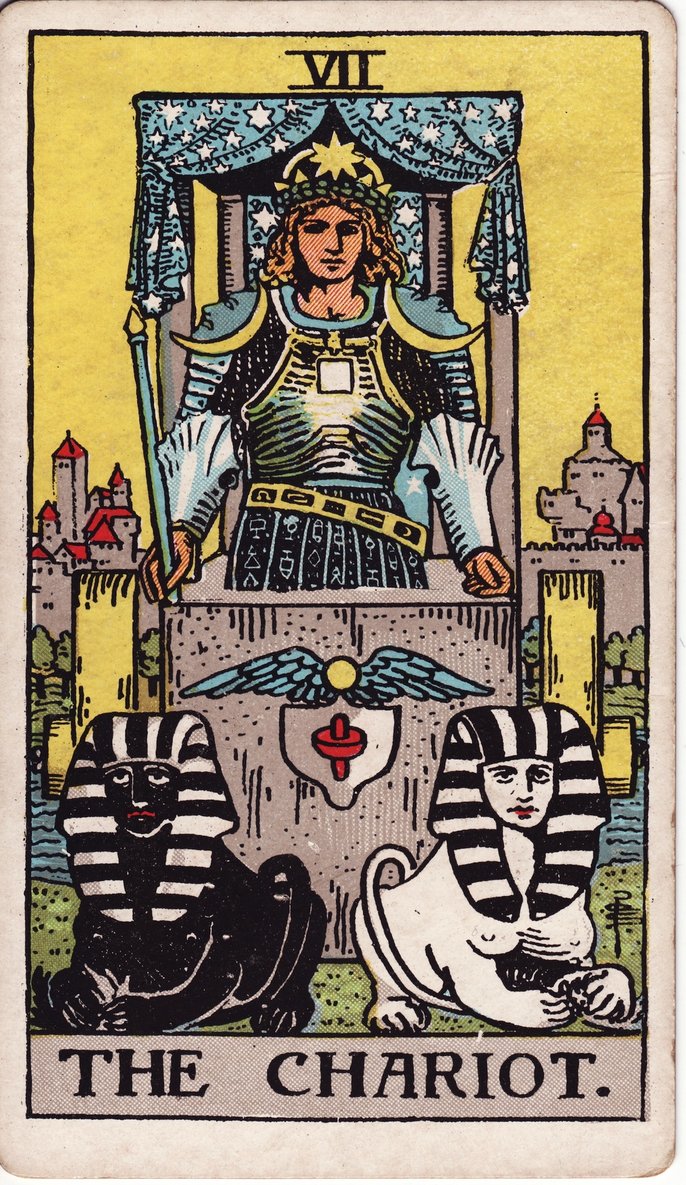
Look at the Rider-Waite image for a moment, because every detail in it is doing work. A young warrior stands upright in a chariot cut from grey stone, a solid cube of a vehicle, more altar than race car. Behind him lie a river and a walled city: home, comfort, everything familiar, already crossed and left behind. Above his head stretches a canopy of white stars on blue cloth, a portable piece of heaven he carries with him wherever he goes. On his shoulders sit two crescent moons shaped into epaulets, one waxing and one waning, each wearing a face of its own. His breastplate bears a golden square, the old sign of stable matter, and on the front of the chariot a winged sun disc gleams above the united symbol of opposites, in case you thought this card was going to be subtle.
And in front of him, the famous pair: two sphinxes, one black and one white, lounging like cats with no intention of going anywhere.
Here is the detail almost everyone misses on the first pass, and it is the whole card: the charioteer holds no reins.
Nothing physically connects him to the creatures that pull his vehicle. He steers with the wand in his hand, the same wand the Magician once raised to the sky, now grown into a scepter, and with something no artist can paint: focused will. The sphinxes are the parts of you that argue. Desire and duty. Fear and appetite. The voice that says go and the voice that says stay. The Chariot does not whip them into agreement. He aligns them, and the vehicle moves because everything inside it finally points the same way.
The crescent moons on his shoulders tell you who he is underneath the armor. This is the card of Cancer, the crab, the sensitive creature in the hard shell. The Chariot is not fearless. He is a feeling person who has built himself a structure sturdy enough to carry those feelings into battle without spilling them.
The stars overhead say his orders come from higher up than his ego. The city behind him says victory costs you your comfort zone. The stone cube says will, once set, does not wobble.
Altogether, the Chariot is the card of willpower, direction, and victory earned through self-command. It is the moment the inner argument ends and the journey actually starts.
The Chariot takes many forms. This guide covers them all.
What does The Chariot Tarot card mean?
Upright, the Chariot means victory, and it is very specific about the kind: victory through discipline, not luck.
This is the card that shows up when you have been circling a decision, a project, a move, or a goal, and the cards lean in and say: enough deliberating. You already know the direction. Drive.
The genius of the image is the missing reins. Real control never comes from white-knuckling the people and circumstances around you. It comes from getting your own opposing impulses, the black sphinx and the white one, pulling in the same direction. Think of every January gym membership that died in February. The plan was fine. The will was split. Half of you wanted the result and half of you wanted the couch, and a divided team loses to a united one every single time.
The Chariot appears when unity is possible. When what you want, what you believe, and what you are willing to do finally line up. That alignment is rare, and it is powerful, and the card’s advice is to spend it while you have it. Momentum is loyal to whoever feeds it.
There is also a literal layer. The Chariot is the Major Arcana’s vehicle, and it can point to actual movement: travel, a relocation, a commute that changes, a journey that matters. The walled city in the background is not a threat, it is a departure point. Everything worth conquering is on the far side of the river you have already crossed.
Notice, too, that the sphinxes are resting and a stone cube hides the rider’s legs. Some readers see a chariot that does not need to strain at all. When your will is truly set, life itself supplies the motion, the way a river carries a boat that has stopped fighting the current. Effort, yes. Struggle, no.
Numerologically, seven is the number of the tested initiate. The Chariot has passed the early trials of the Fool’s journey and won his first command. He does not know everything, and unlike the High Priestess he holds no secret answers. What he has is direction, and a refusal to be talked out of it.
So when the Chariot arrives upright, hear it plainly: pick a lane, commit to it, armor up, and go. The win is available. It simply is not available to a driver who keeps one foot on the brake.
The Chariot Keywords:
- Willpower
- Victory
- Determination
- Focus
- Direction
- Momentum
- Self-discipline
- Ambition
- Drive
- Control
- Confidence
- Travel
- Triumph over obstacles
- Decisive action
What does The Chariot mean when Reversed?
Flip the Chariot and the vehicle is still moving. That is the problem. Nobody agreed on where.
The reversed Chariot describes two failure modes, and they look like opposites until you realize they share a root. The first is forcing: gripping the wheel so hard your knuckles go white, pushing a plan that has stopped working, mistaking stubbornness for strength. The second is drifting: no direction at all, letting life toss you from lane to lane, waiting for a destination to choose you. One driver is doing too much, the other has left the seat entirely, and both end up somewhere they never intended to be.
Ask yourself honestly which one you are right now. Are you dragging two unwilling sphinxes uphill by brute force, exhausted and calling it dedication? Or are you parked, engine idling, telling everyone you are just about to leave?
The reversed Chariot also warns about what happens to the charioteer’s armor when it stops protecting and starts imprisoning. Remember, this is Cancer’s card, a soft creature in a hard shell. Reversed, the shell wins. Emotions get sealed under the breastplate until they leak out sideways as irritability, road rage energy, snapping at people who did nothing wrong. A tantrum with a steering wheel is still a tantrum.
Aggression, rivalry, and ego collisions are classic reversed Chariot territory. So is the peculiar misery of the person obsessed with winning who no longer remembers what the prize was for. When every conversation becomes a competition and every setback a personal insult, the vehicle is running on fumes and pride.
The medicine is almost embarrassingly simple. Pull over. Stop. Look at the map. A pause is not a defeat; it is the only position from which you can actually change direction. You cannot steer by pushing harder, and you cannot correct course at full speed.
Then, once you can see clearly, choose one destination, on purpose, and start again slowly. The reversed Chariot never says you are incapable of victory. It says you are currently spending victory-level energy on motion that goes nowhere, and that the first honest act of willpower available to you is braking.
The Chariot Reversed Keywords:
- Lack of direction
- Forcefulness
- Aggression
- Scattered energy
- Loss of control
- Spinning your wheels
- Burnout
- Obstacles
- Self-doubt
- Recklessness
- Rivalry
- Giving up
The Chariot as How Someone (He/She) Sees You
When the Chariot represents how someone sees you, congratulations: you are the person with the plan.
They see drive. They see the friend who does not just talk about the trip in the group chat but actually books the cabin, the coworker who says “I’ll handle it” and then, astonishingly, handles it. In a world full of people waiting for permission, you read as someone who grants it to yourself, and that is magnetic.
There is admiration in this view, and often a little envy, and sometimes a quiet hope that your momentum is contagious. People near a Chariot tend to sit up straighter. They also tend to assume you are more confident than you actually feel, because your armor is convincing. The crescent moons on your shoulders, the tender Cancer underneath, they cannot see any of that. They see the breastplate.
Which is worth knowing, because it means the people around you may not offer softness unless you ask for it. They think you do not need it.
If you are wondering how a specific person sees you and they are not around to ask, it helps to know whether you can read for someone who is not present before you pull cards on their behalf.
Overall this is a strong card to receive here. You are seen as capable, decisive, going somewhere. Just remember that “impressive” and “approachable” sit at opposite ends of the same drawbridge. Lower it now and then.
The Chariot Reversed as How Someone (He/She) Sees You
Reversed in this position, the armor is still visible. It is just no longer flattering.
They may see you as pushy: the person who confuses leading with steamrolling, who treats every plan that is not their plan as an obstacle. Around this version of you, people go quiet, not because they agree but because arguing feels like stepping in front of traffic. If people have stopped offering opinions in your presence, do not mistake that silence for consensus.
Or they see the opposite: someone stalled. All revving, no motion. The friend with seven ideas and no follow-through, the perpetual “next month I’m really going to start.” They may still be fond of you, but they have quietly stopped believing your announcements, and that is a hard credibility to win back with anything except finished things.
Either way, the reversed Chariot here is a perception problem with a real cause underneath it. The fix is not a rebrand. It is one visible act of steady, non-forced follow-through. Pick something small, complete it, and let them notice on their own. Vehicles are judged by where they actually arrive.
What does The Chariot mean in Love?
The Chariot brings drive into your love life, and drive in romance is a spicy ingredient: exactly right in some dishes, overwhelming in others.
If you are single, this card is wonderful news with an instruction attached. It favors pursuit. Not games, not “wait three days to text,” but honest, decisive interest. Ask the person out. State what you want. The Chariot is the energy of the suitor who crosses the river and shows up at the gate, and that kind of clarity is rare enough to be genuinely attractive. The card only asks that your confidence stay connected to respect. A conqueror’s energy is for conquering circumstances, never a person’s boundaries.
In an established relationship, the Chariot usually means the vehicle is ready for the next stretch of road: moving in together, the shared lease, the ring, the baby conversation, the move to another city. It is the card of a couple that stops idling and shifts into drive.
But here is the part to sit with. A relationship is two sphinxes, one vehicle. Two wills, two histories, two sets of fears, pulling one shared life. The Chariot upright says the pulling can be synchronized, and that synchronizing it is the actual work of love. Not agreeing on everything. Agreeing on direction.
So have the direction conversation, the real one. Where are we going? Do we both actually want that, or has one of us been politely riding along? The armored charioteer would rather know.
And remember what is on his shoulders: moons. Feeling. Tenderness under the plate metal. The strongest thing you can do in love, says this card, is drive with the armor open.
What does The Chariot Reversed mean in Love?
Reversed in love, the Chariot nearly always means a control problem or a momentum problem. Sometimes both, taking turns.
The control version looks like this: one person has quietly become the driver of everything. Where you eat, whom you see, how fast the relationship moves, how every argument ends. The other person has been demoted from co-pilot to passenger, and passengers eventually do one of two things: go numb or grab the wheel. If you recognize your relationship here, understand that the issue is not any single decision. It is that the vehicle only has one set of hands on it. Love steered by force is not devotion; it is a slow leak.
The momentum version is quieter. The relationship is stuck in neutral. Same fights on rotation, same “we should really” plans that never book, anniversaries arriving like mile markers on a road going nowhere. Nobody is cruel. Nobody is driving, either.
There is also the rushing variant for new romance: intensity mistaken for intimacy, the whirlwind that goes from first date to weekend trips at a speed that leaves no time to actually learn each other. Passion is a fine engine and a terrible navigator.
The reversed Chariot’s counsel is the same in every version: stop the car and talk. Both hands visible, both wills on the table. If the conversation keeps skidding, a structured relationship tarot spread can slow it down enough to see where the pull is actually uneven.
What does The Chariot mean in Friendship?
As a friendship card, the Chariot is the friend who moves the plan from the group chat into the real world.
Every circle has one. Forty messages debating the weekend, and then one person types “booked it, here’s the address, be there at seven.” That is Chariot friendship: momentum on behalf of people you love. If you have a friend like this, the card may be pointing at them and telling you to appreciate the logistics as the love language they are. If nobody in your circle is like this, the card is looking at you, recruit.
Chariot friendships thrive on shared motion. Road trips, training for something together, helping each other move apartments, building a thing. These are alliance friendships, closer to teammates than to drinking buddies, and they produce a particular loyalty: the friend who shows up with a truck and no questions.
The card also honors friendly competition in its healthy form. The gym partner who lifts a little more so you push a little harder, the two of you dragging each other toward better versions of yourselves. Two chariots racing the same direction cover twice the road.
One caution, gently: drivers can forget to ask where the passengers want to go. If you are the engine of your friend group, check occasionally that the itinerary is shared and not just tolerated. The strongest alliances are the ones where the wheel actually changes hands.
What does The Chariot Reversed mean in Friendship?
Reversed in friendship, the competition has curdled or the engine has died.
Curdled competition is the friend for whom everything is a scoreboard. Your good news makes them visibly recalculate their standing. Your setbacks relax them a little. That is no longer a friendship; it is a rivalry wearing a friendship’s clothes, and the reversed Chariot suggests you name it, at least to yourself. You cannot ride in one vehicle with someone who is secretly racing you.
The dead engine version is sadder and more common: the friendship that survives entirely on inertia. You meet, you run the same conversational loop, you part, nothing is built or shared or risked. Or the effort has become fully one-directional, one person always driving, planning, reaching out, while the other simply rides. Ask yourself the mechanic’s question: if I stopped supplying momentum, would this friendship move at all?
There is also the steamroller friend, the one whose plans are the only plans, whose preferences win by sheer volume. If dissent has quietly disappeared from your friendship, somebody is being dragged.
None of these verdicts are final. The reversed Chariot does not say end it; it says stop coasting. Change the route, redistribute the driving, have the awkward conversation. A friendship, like a chariot, is rebuilt while it is stationary.
What does The Chariot mean in Career?
In career readings, the Chariot is one of the best cards in the deck, because careers are exactly where discipline outperforms talent.
This is the card of the promotion pursued and won, the certification finished, the business launched, the project shipped. Its message to your ambition is direct: the door you keep glancing at will open to a push, so push. Apply for the role that feels one size too big. Pitch the client. Ask for the raise, with your results listed and your voice steady. The Chariot does not wait to feel ready, because it knows readiness is mostly a story we tell ourselves about later.
Money follows the same physics here. The Chariot’s wealth is built the boring, unstoppable way: consistent effort, automated savings, debts paid down in ordered attacks, income growing because skills grew first. No lottery energy anywhere in this card. The stone chariot is not fast, it is inevitable.
Two practical notes hide in the imagery. First, the no-reins detail: at work, real authority is self-command. The colleague who controls their calendar, their focus, and their reactions ends up steering rooms full of people with louder voices. Guard your deep work hours like the charioteer guards his vehicle. Second, the single direction: the Chariot wins because it does not pull five projects at once. If your energy is split across a day job, two side hustles, and a course you never finish, the card’s advice is triage. One arrow, like the Ace of Swords, cuts. A handful of arrows just gets dropped.
Literal readings apply too: this card favors careers involving vehicles, travel, logistics, athletics, and any field where relocation could accelerate everything.
What does The Chariot Reversed mean in Career?
Reversed in career questions, the Chariot describes motion without progress, and every workplace produces it in bulk.
The busiest person in the office is often the most stalled: forty hours of meetings, inboxes, and urgent little fires, zero hours of the work that would actually change their trajectory. If your weeks are full and your goals are untouched, that is the reversed Chariot, wheels shrieking, vehicle stationary. Track one honest week of your time and look at where the horsepower actually went.
It can also mark the doomed project pushed past its expiry date. Sunk cost is the reversed Chariot’s favorite trap: we have come so far, we cannot stop now. But a vehicle pointed at a cliff does not need more commitment, it needs a steering input. Sometimes the strongest move in a career is the professional U-turn, made early, made calmly, and explained without shame.
Watch for workplace power struggles too. Turf wars, credit grabs, the manager who must control every detail because trust feels like falling. If you are in one, notice that these contests consume exactly the energy that promotions are made of. Rarely is the prize worth the fuel.
And check the tank itself. Burnout is this card’s bluntest reversed meaning: the driver slumped at the wheel, running on caffeine and obligation. Ambition without recovery is just a slower resignation letter. Pull into the rest stop before the rest stop chooses you.
The Chariot as How Someone Thinks of You
When the Chariot describes someone’s private thoughts about you, you occupy a specific mental shelf in their head. The label on it reads: going places.
This is subtly different from how they see you in person. In their unguarded thoughts, you function as a benchmark. When they consider their own choices, you come to mind: what would you have done, would you have hesitated like this, would you have finished by now. People measure themselves against Chariots, usually silently, occasionally out loud at two in the morning.
If your question is romantic, this card as their thoughts is promising and serious. They do not think of you as a maybe. Cancer’s card carries protective, committed intent, so their thoughts likely run toward the future tense: plans, scenarios, the two of you somewhere down the road. When the Chariot thinks of someone fondly, it thinks in destinations.
They may also think of you as armored. Impressive, driven, and slightly unreadable, the feelings tucked under the breastplate where nobody can inspect them. Some of the mystery working in your favor here is really just distance.
Enjoy the respect this card carries. And if this person matters to you, let them catch a glimpse under the armor occasionally. People are loyal to what they admire, but they fall in love with what they are allowed to actually see.
The Chariot Reversed as How Someone Thinks of You
Reversed, the private assessment has a dent in it.
Most commonly, they doubt your follow-through. Perhaps they have watched a few announced departures that never left the driveway, and now, when you share a plan, a small internal voice of theirs says “we’ll see.” This is rarely spoken and rarely cruel. It is just the ledger people keep, and right now your entries show more ignition than mileage.
Alternatively, they think of you as a rival. In their head there is a race between you, one you may not know you entered. Your wins read to them as their losses. If this is a coworker or an old friend with a competitive streak, factor it in before you share your next plan with them; sharing your route with someone racing you is questionable strategy.
A third possibility: they think of you as forceful. When they imagine disagreeing with you, they pre-experience the collision and decide against it. You live in their mind as weather to be planned around rather than a person to negotiate with.
None of these are verdicts on who you are. They are impressions, and impressions respond to evidence. Finish something quietly. Yield a point gracefully. Let one of their ideas win on its merits. Minds update slower than we would like, but they do update.
What does The Chariot mean in Conflict?
In a conflict reading, the Chariot upright is the card of the winnable fight, fought correctly.
Correctly means: with armor, with strategy, and with a destination. The charioteer does not brawl. He engages when the ground favors him, protects what is soft, and never forgets what the fight is actually for. Before your next difficult conversation, borrow his checklist. What outcome am I driving toward? What is my armor, meaning what facts, boundaries, and composure do I bring? And what will I refuse to do no matter how provoked I get?
That last one matters most. In conflict, the person who keeps command of themselves usually ends up commanding the situation. Anger is a horse, useful in harness, catastrophic in charge. The Chariot yokes it.
Notice also that the sphinxes on the card are opposites at rest. The conflict the Chariot wins best is the one where opposing forces get aligned rather than annihilated. Where can your opponent’s interest and yours point the same direction? A negotiation that finds shared destination beats a victory that salts the ground, because you often have to keep living in the city behind you.
Pick the battle deliberately, though. The Chariot fights for territory that matters: your boundary, your reputation, your people. It does not deploy full armor over a parking spot. Strength that spends itself on everything holds nothing.
If the conflict is truly worth it, this card says you have the will to see it through. Steady hands. Forward.
What does The Chariot Reversed mean in Conflict?
Reversed in conflict, the Chariot is the collision card, and it warns that this fight is being driven by momentum rather than by anyone’s actual interests.
You know this kind of fight. It escalated three exits back, nobody remembers the original grievance with any precision, and both parties are now fighting about the fighting. Tone, disrespect, who started it, who always does this. Two chariots locked wheel to wheel, dragging each other into a ditch neither was aiming for. In a tug of war, no one wins by pulling harder forever. Someone wins by letting go of the rope in a direction of their choosing.
The reversed Chariot suggests that someone might as well be you, and that letting go is not surrender. Deescalation is a steering input. “Let me think about that and come back tomorrow” is not weakness; it is the only sentence that reliably stops a runaway argument.
Watch for the control layer underneath. Many reversed Chariot conflicts are not about the stated topic at all. They are about who drives: in the marriage, on the team, in the family. If every disagreement mysteriously becomes existential, ask what the wheel represents and whether it could possibly be shared.
And keep your armor on in one specific sense: do not hand your self-command to someone whose only power is provoking you. The person who can make you swerve owns your vehicle. Reversed, this card’s whole warning is: do not give them the wheel.
The Chariot as Feelings
As a feelings card, the Chariot describes emotion under armor: intense, directed, and deliberately contained.
If you are asking how someone feels about you, this is not a lukewarm card. The Chariot does not do lukewarm. They feel driven toward you. Drawn, motivated, protective, already further down the road in their head than anything they have said out loud. Cancer rules this card, remember, so beneath the discipline there is real tenderness, moon-shaped and easily bruised. What reads as reserve is very often care wearing a breastplate.
The container matters as much as the contents. This person feels strongly and is managing it: pacing themselves, staying composed, determined not to arrive at your gate a mess. With a Chariot, the depth of feeling is usually several sizes larger than the display of feeling. Do not measure the engine by the noise.
If the question is about your own emotional state, the card describes contained intensity from the inside: that focused, leaning-forward feeling of wanting something and having decided to go get it. It is a clean-burning fuel, and the card blesses it. Feelings, says the Chariot, are horses. You do not shoot them and you do not let them stampede. You harness them and they take you somewhere.
One check before you ride off: containment should be pacing, not hiding. Emotion that never gets voiced eventually goes feral. Say the thing, in armor if you must, but say it.
The Chariot Reversed as Feelings
Reversed, the feelings have either seized the wheel or been locked in the trunk, and both arrangements end badly.
Seized the wheel looks like emotional weather driving every decision. Texts sent at full throttle and regretted by morning, moods that yank the whole day sideways, a heart doing ninety in a school zone. If this is you lately, the card is not scolding the feelings themselves. It is pointing at the empty driver’s seat. Feelings are legitimate passengers and terrible chauffeurs.
Locked in the trunk is the quieter dysfunction, and very on-brand for an armored card. Everything is fine, you say, at increasing volume, while the sealed cargo thumps. Suppressed emotion does not evaporate. It reroutes: into irritability, into a snapped remark at someone innocent, into the strange flatness where you cannot feel much of anything. Armor that never comes off stops being protection and becomes a container you live inside.
If you are asking about another person’s feelings, the reversed Chariot often means turbulence they cannot yet steer: they run hot and cold, accelerate then vanish, want you and want control of wanting you. Their two sphinxes are pulling opposite directions. That is genuinely their road to sort out, and the card cautions you against volunteering to be dragged along while they do.
The repair, either way, begins with parking. Name the actual feeling, out loud or on paper. Cargo that has been inventoried stops thumping.
The Chariot as a Situation
As a situation, the Chariot means you are in a moving vehicle. Decisions now are steering, not planning.
Something in your life has momentum: the relationship acquiring weight, the job in motion, the move half-arranged, the project rolling downhill in the good way. Situations like this feel exhilarating and slightly out of hand, because motion always involves less control than we would like. The card’s counsel is to steer rather than brake. Windows like this one, where effort converts directly into distance, are rarer than they feel while you are inside them. Push now, coast later.
The Chariot situation often includes a threshold you have already crossed, whether you have admitted it or not. The river and the walled city sit behind the charioteer, not ahead of him. Applied to your life: the resignation letter mostly drafted, the feelings already spoken, the lease nearly signed. When this card marks your situation, retreat to the old comfortable city is largely theoretical. Forward is simply the honest name of the direction you are already facing.
Expect the situation to test alignment above all. Fast-moving circumstances expose divided intentions immediately, the way highway speed exposes a wobbling wheel. If part of you is not fully aboard, you will feel the shake. Fix the alignment, not the speed.
Practically: travel, vehicles, relocations, and deadlines are often literally present in Chariot situations. Check the tires, in every sense.
The Chariot Reversed as a Situation
Reversed as a situation, you are in gridlock. The engine is running, the fuel is burning, and the scenery is not changing.
This is the job where every week is identical, the negotiation both sides have dug into, the house purchase snarled in delays, the relationship conversation that loops without landing. Stuck situations have a particular cruelty: they consume as much energy as progress does. You end the day exhausted and precisely where you started, which is the reversed Chariot’s signature feeling.
Usually one of three things is true. The situation has two drivers fighting for one wheel, and until the control question is settled, nothing else can be. Or it has no driver at all, everyone waiting for someone else to decide, a committee-shaped vehicle rolling wherever the road tilts. Or it is pointed at a destination nobody actually wants anymore, maintained purely by sunk cost and the awkwardness of saying so.
Identify which one is yours, because the exits differ. Two drivers need a genuine negotiation about who steers what. No driver needs someone, likely you, to simply take the wheel and announce a direction. Wrong destination needs one brave sentence: “I do not think we want this anymore. Do we?”
What the reversed Chariot forbids is the current strategy, which is revving in place and hoping. Traffic does not clear because you gripped the wheel harder. Something has to be steered. Situations, like vehicles, only respond to inputs.
The Chariot as Intentions / What Someone Wants
As intentions, the Chariot means this person wants to move things forward, and they want to be the one driving.
Applied to romance, that is mostly excellent news. This is not a browser. The Chariot’s intent has a destination in it: they want the relationship to progress, to become official, to advance to the next recognizable stage. Cancer’s protective streak runs through this card, so the wanting usually includes wanting to shelter you, provide for you, be your armored escort through a sharp-edged world. When a Chariot wants you, you will notice the momentum: plans made, follow-through delivered, the future casually spoken of as a shared address.
The asterisk is the driving part. Wanting to lead is not sinister, but it is a preference you should see clearly. This person’s picture of the future has them at the wheel of it. The question worth asking, of them and of yourself, is how they respond when you reach for the wheel too. Take charge of the next plan and watch. A healthy Chariot is delighted to be driven sometimes. An unhealthy one grips.
Outside romance, the intent is straightforwardly ambitious: they want the deal closed, the project greenlit, the win banked. They want progress more than they want comfort, and they will trade a great deal of the second for the first. Deal with them accordingly: bring them a destination, not a discussion.
The Chariot Reversed as Intentions / What Someone Wants
Reversed, the intention question comes back tangled, and the tangle itself is your answer.
The most common reading: they want control more than they want the stated thing. Underneath the professed goal, the relationship, the deal, the collaboration, sits a stronger craving to hold the wheel, set the pace, and keep every exit accessible. You will recognize this by the pattern: enthusiasm whenever they steer, sudden coldness whenever you do. What they want from you, bluntly, may be a passenger.
Second reading, at least as common: they do not know what they want. Their sphinxes pull opposite ways. They want closeness and want distance, want commitment and want the open road, and so they produce that maddening hot-cold, surge-retreat rhythm that keeps you awake doing interpretive work at midnight. Here is the mercy in the card: stop interpreting. Mixed signals are not a code to crack. Mixed signals are the message, and the message is “divided.”
Third possibility, rarer but worth naming: stalled wanting. They want to want things. The engine of desire itself is flooded, ambition damp, and they could not give you a destination because they cannot currently give themselves one.
In all three cases the reversed Chariot hands you the same counsel: do not board a vehicle whose driver cannot name the destination. Ask directly, once, where this is going. Then believe the answer, including the mumbled ones.
Is The Chariot a Yes or a No?
The Chariot is a yes. A strong one, with an engine attached.
But hear the whole sentence, because this card’s yes has a signature condition: yes, through effort. The Chariot never promises outcomes delivered to the couch. It promises that the road is open, the vehicle works, and your will is sufficient, provided you actually drive. Ask “will I get the job?” and the Chariot answers: yes, if you apply, prepare, and push. Ask “will this relationship work?” and it answers: yes, if you both steer it on purpose. It is less a fortune than a green light, and green lights reward the driver who accelerates.
Yes questions about travel, moves, vehicles, competitions, and anything requiring nerve get an extra underline. This card loves an audacious plan with logistics behind it.
Reversed, the answer shifts to not yet, or not this way. Something is misaligned: the timing, the method, or your own divided will. It is rarely a flat never. It is the deck telling you the current approach stalls, and a corrected approach might not. Fix the direction, then ask again.
One honest caveat applies to every yes/no reading: a single card is a compass, not a contract, and it is worth understanding why tarot cards can sometimes be wrong before you bet the farm on one draw. The Chariot itself would approve of that diligence. Confidence, in its book, always rides with preparation.
The Chariot as a Place
As a place, the Chariot is anywhere built for motion, and it is the rare card that can simply mean your car.
Vehicles first, and literally: cars, trains, planes, motorcycles, ships. The daily commute, the long drive that clears your head, the front seat where half of life’s real conversations happen. If a reading points to where something will occur or where you should be, the Chariot says: in transit. On the road. Between here and there.
By extension it covers the architecture of movement: highways, stations, airports, bridges, harbors, the river crossing itself. Places you pass through rather than stay, which carry their own strange energy, everyone in them mid-journey, nobody home.
The card also claims arenas of striving. Stadiums, racetracks, gyms, dojos, competition floors, anywhere discipline performs in public. The charioteer is, among other things, an athlete presenting his triumph, so places of training and contest are native ground.
And in the most personal reading, the Chariot is the new city. The place beyond the walls you grew up inside. If you have been circling a relocation, this card as a place practically points out the windshield: your address is not final. Home, for a Chariot, is partly a direction.
If you need one image to hold: the driver’s seat, hands at ten and two, tank full, city shrinking in the mirror.
The Chariot Reversed as a Place
Reversed, every one of those places jams.
The traffic jam is the emblem: a thousand vehicles built for speed, stationary, engines idling, drivers marinating in frustrated momentum. As a place-answer this can be literal, expect delays, gridlock, the breakdown lane, the airport chairs where flights go to be postponed. Travel plans under this card deserve buffer time and backup routes, because friction is in the forecast.
Figuratively, the reversed Chariot marks places where you feel stuck: the parking garage of a job you have outgrown, the apartment that was supposed to be temporary five years ago, the hometown that fits like a shoe two sizes small. Also, notably, the city you cannot stop circling: the ex’s neighborhood, the old campus, any geography you revisit not because it feeds you but because leaving it never got finished.
It can also point to places of collision and contest gone sour: the crash site, the arena after a loss, the office where turf wars have replaced work.
Ask one diagnostic question about any place in your life right now: does this place move me, or hold me? Reversed, the Chariot suspects you already know of one address in the second category. Places are vehicles too. Some carry you somewhere, and some are just parked buildings you sit inside while time drives past.
The Chariot as an Obstacle / Challenge
When the Chariot itself appears as the obstacle, the diagnosis is elegant and a little uncomfortable: the thing blocking the vehicle is the driver.
Specifically, a divided will. Your black sphinx and white sphinx are pulling in different directions, and the resulting motion is zero. You want the promotion and you want to never be perceived. You want the relationship and you want every exit kept open. You want to write the book and you want to have already written it without the writing part. None of these are character flaws. All of them are physics problems: opposing forces, net force zero, vehicle stationary.
The challenge, therefore, is not effort. You are probably already tired, which is the tell, since fighting yourself burns double fuel. The challenge is alignment. Sit down with the disagreement inside you and hold an honest negotiation. What does the reluctant half actually fear? What would it need in order to pull? Often the resistant sphinx is guarding something real, rest, safety, an old wound, and it stops resisting the moment its cargo is acknowledged.
The Chariot as obstacle can also mean overcommitment: seven chariots, one driver, nothing arriving anywhere. If your goals list reads like a fleet, the obstacle is arithmetic. Choose the one vehicle that matters most this season and let the others sit in the garage without shame.
Either way, the wall in front of you was built in-house. Good news: so is the demolition crew.
The Chariot Reversed as an Obstacle / Challenge
Reversed as an obstacle, the problem inverts: not stalled will, but momentum pointed the wrong way.
This is the sunk-cost obstacle, and it is one of the hardest in the entire deck because it disguises itself as a virtue. Persistence. Loyalty. Not being a quitter. Meanwhile the degree you no longer want, the business model that stopped working, the relationship sustained by anniversary math, the identity you built at twenty-five, all of it barrels forward on accumulated momentum, and stopping feels like betraying every mile already driven. Here is the sentence to tape to the dashboard: miles already driven are spent regardless. The only real question is where the next miles go.
A moving vehicle is genuinely harder to redirect than a parked one. Expect the course correction to cost something: awkward conversations, a public change of story, grief for the destination you are giving up. The reversed Chariot confirms the cost and says pay it anyway, because the alternative is arriving, efficiently and on schedule, somewhere you do not want to be.
The other reversed obstacle is force itself. If every strategy in your kit is a harder push, then pushing is now the blockage. Doors that will not open to shoving sometimes open to a knock, a key, or standing back far enough to notice it is labeled pull. Try the strategy your pride rejected first.
The Chariot as Action
As an action card, the Chariot is the deck at its least ambiguous: go.
Not “reflect on going.” Not “journal about the pros and cons of going,” you have done that, the notebook is full. Send the application today. Book the flight. Post the listing. Make the call whose number you have been staring at. The Chariot’s conviction is that clarity is created by motion at least as often as it precedes it. You learn the road by driving it, and half of what you are calling preparation is fear wearing a lanyard.
The action it prescribes has a particular shape, though: decisive, but not wild. The charioteer moves after the armor is on and the direction is chosen. So the full instruction is a two-step. First, thirty minutes of cold planning: the goal in one sentence, the next three concrete moves, the thing you will refuse to be distracted by. Then, execution without renegotiation. The plan gets revised at the next milestone, not at every twinge of doubt. Doubt is a passenger; it may ride, but it may not touch the wheel.
Cut the side quests while you are at it. The Chariot takes one direction at a time, and so should this week of your life. Whatever the reading is about, that thing gets your best hours, and the other seventeen projects get a polite “after.”
Momentum compounds. Today’s small departure is next year’s changed address. Drive.
The Chariot Reversed as Action
Reversed as action, the instruction flips with equal clarity: pull over.
This is the deck telling you that the next strong move is a full, deliberate stop. Not quitting, stopping. There is a difference, and the reversed Chariot lives inside it. A driver who pulls over to read the map has not abandoned the journey; he is the only one on the highway guaranteed not to be lost an hour from now.
So pause the launch. Delay the reply, especially the one you have drafted in anger, that message is a vehicle with cut brakes. Take the weekend before signing. Tell the recruiter, the buyer, the partner: “I want to get this right, give me two days.” Anyone worth dealing with respects that sentence, and anyone who pressures you against it has just told you something valuable about the road ahead.
Use the stop for an alignment check, three questions, honestly answered. One: is this still the right destination, or am I driving on autopilot toward last year’s goal? Two: is the current method working, or merely familiar? Three: what am I refusing to see because seeing it would mean turning around?
Then, and this is the part people skip, actually rest. The reversed Chariot often marks a driver who has been white-knuckling for months. Sleep. Eat something green. Let the engine cool. The road will still be there, and you will drive it far better as a human than as a fume-running machine.
The Chariot as Advice
As advice, the Chariot hands you a field manual with three lines in it.
Line one: choose one destination. Not five. Your energy is a single tank of fuel, and every additional goal siphons it. Decide what this season of your life is actually for, say it out loud in one sentence, and let that sentence veto things. The veto is the point. A direction that excludes nothing is not a direction, it is a mood.
Line two: build the structure, because motivation will not save you. The charioteer does not feel like conquering every morning. He has armor, a vehicle, a route: systems that carry him on the days the feeling fails. Yours will look humbler, same schedule every day, the workout that happens before the phone turns on, money moved to savings automatically, the standing weekly hour for the dream project. Discipline gets slandered as self-punishment. It is the opposite. Discipline is just love with a schedule.
Line three: wear armor, keep the moons visible. Boundaries, composure, a firm no: yes, all of it, the world is sharp and you should be covered. But the charioteer wears crescent moons on his shoulders where everyone can see them. Protected is not the same as sealed. Let the people who have earned it see what the breastplate covers, and mind your health while you march, since chariots, like bodies, fail at the axle you never inspect.
Then stop reading advice, including this. Drive.
The Chariot Reversed as Advice
Reversed, the advice is the one the driven least want and most need: loosen your grip.
Start with the wheel itself. Somewhere in your life you are steering something that would genuinely run better with your hands off it: a grown child’s choices, a partner’s habits, a colleague’s method, the outcome of a thing you have already done your part of. Control feels like safety, but past its useful range it functions as drag, on them and on you. Make an actual list titled “mine to steer” and another titled “not mine,” and be ruthless about the second column. Half of your exhaustion lives there, paying no rent.
Next, audit the destination before spending another mile on it. The reversed Chariot frequently catches people flawlessly executing an obsolete plan, hitting every milestone on the road to a place they stopped wanting in a previous version of themselves. Success in the wrong direction is the most expensive failure available. Ask the terrifying question: if I were starting from zero today, would I choose this course? If the honest answer is no, your next act of willpower is a turn, not a push. If the answer will not come clear on its own, a guidance spread can lay the fork in the road out where you can finally look at it.
Last: apologize where your driving left tire marks on people. The forceful season you may just be exiting had witnesses. A Chariot who can say “I steamrolled you, I’m sorry” is stronger than one who never brakes. That, too, is command.
The Chariot as an Outcome
As an outcome card, the Chariot promises arrival. The campaign this reading describes ends in victory, and in the specific, satisfying kind: the earned kind.
Expect the win to trace back to effort in an almost auditable way. This is not the Wheel’s lottery or a stroke of fairy-tale luck; it is the offer landed after the fortieth application, the finish line crossed on legs that trained through winter, the business that survives because you steered it weekly for two unglamorous years. When it comes, you will be able to point at the road behind you and account for every mile, and there are few feelings in life more solid than that one.
Two features of this particular ending are worth knowing in advance. First, it usually involves literal or figurative movement: outcomes under the Chariot have a tendency to come with new addresses, new titles, new territory, a life that looks different out the window. Second, and better: the driver arrives changed. The discipline built during the campaign does not dissolve at the finish line. You keep the engine. The person who conquered this becomes the standing answer to every future “but can I?”
One gentle footnote from the card’s geometry: a chariot that arrives does not stay parked forever, and seven is a number of cycles, not conclusions. Enjoy the triumph fully, throw the dinner, take the photos. Then expect, sooner than you think, the pleasant itch of a new horizon. Victors, it turns out, stay victors by staying drivers.
The Chariot Reversed as an Outcome
Reversed as an outcome, the reading forecasts one of three endings, and knowing which is approaching lets you steer out of it while steering is still possible.
Ending one: the stall. The project, deal, or relationship this reading describes runs out of momentum short of the destination. Not a crash, a coasting halt: energy dissipated, attention divided, the thing quietly filed under “someday.” If you want a different ending, the fix must happen now, in the middle miles, where consistency is boring and decisive. Outcomes are lost on ordinary Tuesdays far more often than on dramatic days.
Ending two: the pyrrhic win. You arrive, technically. The title is yours, the fight is won, the point is proven, and the cost sits in the passenger seat: the burned-out body, the neglected marriage, the friendships flattened on the way past. The reversed Chariot as outcome asks you to price the victory honestly before the final push, because some trophies are receipts.
Ending three: the wrong address. Flawless execution, obsolete destination. You get exactly what you set out for and discover the self who wanted it moved away years ago.
The shared thread is worth saying plainly: none of these endings is fate. This card describes the current trajectory, nothing more. Trajectories obey steering. Slow down, recount the cost, update the destination, and the forecast, unlike a delivered outcome, rewrites itself immediately.
The Chariot in the Future
In the future position, the Chariot is an incoming season of momentum, and it invites you to get ready the way you would for any green light: fuel up now.
Something ahead of you is going to start moving, likely faster than expected. An opportunity that requires a quick decisive yes, a promotion with a relocation stapled to it, a relationship that finds sudden traction, a door that opens for exactly as long as doors open. Futures under this card reward the prepared. Update the resume before it is needed. Save the deposit before the listing appears. Have the conversation with yourself about what you would say yes to, so the actual yes takes four seconds instead of four anxious weeks.
Travel and movement feature strongly: journeys, moves, new territory, a stretch of life where the scenery changes at highway speed. Some readers time this card in sevens, seven weeks, seven months, a seven-mile stretch of some kind. Hold timing loosely; hold readiness tightly.
Expect the coming season to demand direction from you, because momentum without direction is just being flung. The stretch ahead will amplify whatever you point it at, which makes the present moment, before the acceleration, the cheapest possible time to choose your heading. Aim now, while everything is still quiet.
And when it starts, and you feel that unmistakable click of a life shifting into drive, do not flinch and do not over-brake. You asked the future a question. It is answering: go.
The Chariot Reversed in the Future
Reversed in the future position, the road ahead contains friction, and the card is telling you early precisely so it costs less.
Expect delays and detours around the plan as currently drawn. The timeline that assumes zero traffic, the launch date with no slack, the itinerary where every connection is tight: build margin into all of it now. Futures under the reversed Chariot punish brittle plans and barely notice flexible ones. The traveler with a buffer day shrugs at the canceled flight; the one without it gets a story they will not enjoy telling.
There may also be a contest of wills ahead: a rival for the role, a negotiation that turns into an arm wrestle, a person in your path whose plan runs perpendicular to yours. Forewarned, you can choose your response in advance, and the card recommends strategy over collision. The driver who anticipates the merge never has to slam the brakes.
Watch, too, for your own future fork: a coming moment when pushing forward will feel righteous and turning will feel like failure, and turning will be correct. Mark it now, while you are calm: “if X happens, I will reconsider instead of accelerating.” Pre-made decisions are the only ones fully immune to momentum.
None of this is doom. A detour is still a road, and every experienced driver has a story about the roadblock that redirected them somewhere better. The reversed Chariot’s future simply requires what its upright twin gets for free: patience, and a loose grip on the map.
The Chariot as a Person
As a person, the Chariot is instantly recognizable: the one in any room who is visibly going somewhere.
They arrive with a plan, and the plan has sub-bullets. Athlete, founder, sergeant, organizer, the parent who runs the household like a well-loved logistics company, the friend whose calendar could survive an audit. Talent is nice, they will tell you, but they have watched discipline lap talent too many times to worship it. Their respect is earned one way: follow-through. Say you will do a thing and then do it, and you have a loyal ally for a decade.
And they are loyal, fiercely, protectively so, because under all that armor this is Cancer’s person: a soft-hearted homebody who learned to soldier. They feel everything and show a curated fraction of it. The people they love get defended like territory. The moons on the shoulders are real; you simply have to be trusted before you are shown them.
Their flaws grow from the same root as their gifts. They can be stubborn past the point of sense, controlling when anxious, brisk with people who move at ordinary speeds, and allergic to admitting the plan failed. They do not ask for help so much as get ambushed by needing it.
Love one well by matching their loyalty, keeping your word, and occasionally, gently, taking the wheel so they remember the passenger seat has a view too.
The Chariot Reversed as a Person
Reversed, this person comes in two models, and you have met both.
Model one: the steamroller. All the Chariot’s force, none of its direction discipline. Every conversation is a contest, every room a territory, every disagreement a challenge to be flattened. They drive fast, cut off feedback, mistake volume for leadership, and leave a wake of quietly resentful people who have learned that yielding is cheaper than arguing. Underneath, almost always, is fear: of losing control, of being seen as weak, of the silence that comes when they stop achieving. It does not excuse the tire marks. It does explain the speed.
Model two: the stalled driver. Equally recognizable, differently exhausting. Enormous engine, perpetual park. This is the gifted friend forever about to start: the business next quarter, the degree next year, the big move after one more season. They can describe the destination in beautiful detail, which is precisely what makes the stationary vehicle so sad to watch. Somewhere their two sphinxes deadlocked, ambition versus fear, and fear has been winning on points for years.
If you are dealing with either, the same rule protects you: do not climb into their vehicle expecting your presence to fix the driving. Steamrollers flatten passengers too, and stalled cars stall with you in them.
If you suspect you are one of them, take heart. Both models are one honest stop, one alignment, and one true direction away from the upright card. The engine was never the problem.
What Zodiac Sign is The Chariot?
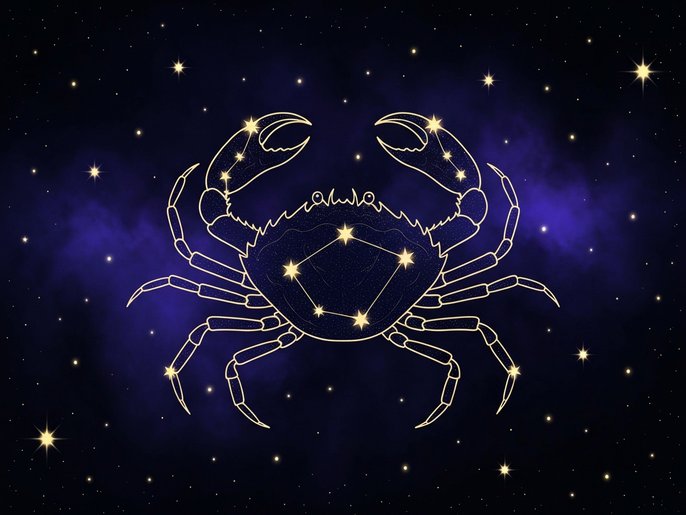
The Chariot belongs to Cancer, and the match is one of the tidiest in the tarot.
Start with the armor. Cancer is the crab: soft body, hard shell, and a sideways approach to anything dangerous. The charioteer’s breastplate is a crab shell forged in a smithy. Both creatures solve the same problem the same way, protecting a tender interior with engineered exterior, and both are routinely misread as cold by people who never got past the plating. The crescent moons on the charioteer’s shoulders seal the identification, since Cancer is ruled by the Moon: feeling, memory, tide, and instinct, worn openly on the armor of a warrior. Sensitivity, says this card, is not the opposite of strength. Properly harnessed, it is the fuel.
Now the part people forget about Cancer: it is a cardinal sign. Cardinal signs initiate. Aries starts the spring, Capricorn starts the winter, and Cancer kicks off summer, which makes the crab a leader, not a hermit. Cancerians do not merely feel deeply; they act on it, building, defending, and mobilizing for the people and places they love. The Chariot is exactly that motion: emotional force converted into forward drive. The homebody who will cross any river for home’s sake.
Even the walled city fits. Cancer is the sign of home, and there it sits behind the chariot, loved and left, because the seventh card’s whole story is a home-loving heart choosing the road anyway.
Element: water, moving like its rivers. Number: seven, the tested. Season: the start of summer, when everything alive accelerates.
Final Thoughts
Strip the Chariot to one sentence and it says this: the war is internal, and the victory parade is external. Every visible triumph on this card, the armor, the vehicle, the conquered road, was won first in the invisible place where a person gets their own divided heart to pull in one direction. Willpower is not gritting your teeth. It is wanting one thing so completely that the argument inside you finally ends.
That is why the charioteer needs no reins, and why the card sits at seven, early in the Major Arcana. It is the first real victory of the Fool’s journey, and pointedly not the last lesson. The very next card, Strength, takes the armor off and tames the lion with bare hands and patience, as if the deck is saying: well driven, now learn what force cannot do. Further down the road, the Star will teach the charioteer to rest under the same night sky he once wore as a canopy.
For now, though, the message is motion. Whatever question brought you to this card, somewhere in your life there is a vehicle idling, a river already crossed, and a direction you have known for longer than you have admitted. The city walls will keep. The sphinxes are waiting on your word.
Say it. Drive.